


Gifting has never been easier
Perfect if you're short on time or are unable to deliver your gift yourself. Enter your message and select when to send it.


25% off your first order with a seed subscription. Skip, pause or cancel anytime.



Sprouting in a mason jar is harder than it looks.
The neck traps water, which is how mold starts. The narrow mouth slows airflow and makes it hard to reach in and pull out a full harvest. The Sprouter has straight walls that drain completely and a mouth 125% wider.
Get the Starter Kit - Up to 25% OFF
1.1 million pounds grown
In 105K+ kitchens
Harvest in 3-5 days
4.9/5 average rating
As Seen On


The DIY reality
The DIY reality
A mason jar can grow sprouts. Plenty of people start there. The trouble is not the seed and it is not the rinsing. It is the jar.
Day 2. Water sitting in the neck.
Day 2. Water sitting in the neck.
You tip the jar to drain it and a little water stays behind in the neck. That is where mold starts.


“No more draining half gallon jars where it's difficult to get the water out esp on day 3&4. No more slimy bits just fresh clean sprouts!”
3
Day 3. Propped at an angle, in the pan you need.
Day 3. Propped at an angle, in the pan you need.
A jar only drains if it sits tilted, so it lives in a bowl or a dish rack. Usually the one you were about to cook with.


“I used to use a jar with a screen lid, and set it at an angle in a pan to drain. Of course that was always the pan I needed to cook something.”
Laurie H. | Verified review
4
Day 4. The screen rusts, the sprouts clump.
Day 4. The screen rusts, the sprouts clump.
Mesh lids and metal bands rust over time, and sprouts cling to the smooth sides of a jar instead of growing as one crop.


“Love the stainless screen (my go to sprouters rust over time). Love the way the sprouts don't clump on the sides like they do in smooth jars.”
5
Day 5. Is this batch safe?
Day 5. Is this batch safe?
With a jar you are guessing.
None of this is you.
It is the jar.
The two things that actually go wrong
Drainage and airflow. A mason jar fails at both. The Sprouter was built for both: straight walls that drain completely and a mouth 125% wider. Both are patented.

Mason jar. Water pools in the neck.

The Sprouter. Drains completely, breathes freely.

Drainage
The angled base holds the Sprouter at the exact pitch sprouts need. Water leaves completely after every rinse, which is one of the biggest factors in avoiding spoilage.
Airflow
The angled base holds the Sprouter at the exact pitch sprouts need. Water leaves completely after every rinse, which is one of the biggest factors in avoiding spoilage.
Side by side
A mason jar works. Plenty of people start
there. This is where the two part ways.
The lid is the third failure point. Mesh screens and metal bands rust over time, and sprouts cling to the smooth sides of a jar. The Sprouter's filter is 304 stainless steel, the glass is straight-walled, and both go in the dishwasher.

vs

Mason jar
Daily routine
A mason jar works. Plenty of people start there. This is where the two part ways.
The lid is the third failure point. Mesh screens and metal bands rust over time, and sprouts cling to the smooth sides of a jar.
The Sprouter's filter is 304 stainless steel, the glass is straight-walled, and both go in the dishwasher.
Daily routine
Drainage
Airflow and harvest
What touches
your sprouts
If a batch fails

Rinse and drain, twice a day
Straight walls drain completely. The base holds it at the exact pitch
sprouts need
304 stainless steel filter. Dishwasher safe
Glass and 304 stainless steel. Never plastic
50 oz. Enough to grow food rather than garnish
Grow Easy Guarantee, plus a one-year warranty

Mason jar
Rinse and drain, twice a day
The neck traps water, which is how mold starts
Depends on the jar and lid
Depends on the jar
Depends on the jar and lid

What a failed batch costs
About a quarter cup of seed and five days of rinsing. Not much. It is the batch that decides whether you keep going, and trapped water is one of the most common reasons home sprouting fails.
The Sprouter loses water when you rinse it. That's what it's supposed to do. Complete drainage is the point.
What a good batch looks like
A quarter cup of seed. Five days. A jar packed full.

“I've made one batch so far and got a whole spinner full with just a quarter cup of seed.”
Deborah R. | Verified review

“My yield was a jar packed FULL of snappy, crisp sprouts!”
Donna B. | Verified review

About a minute, twice a day
About a minute,
twice a day
You rinse, you drain, you walk away. Most people fold it into things they already do. Rinse when the coffee is brewing, rinse again after dinner. It takes about as long as brushing your teeth.
The Sprouter does the rest. It holds the angle for you, so water drains out completely and air keeps moving until harvest day.

1
Add your seeds.
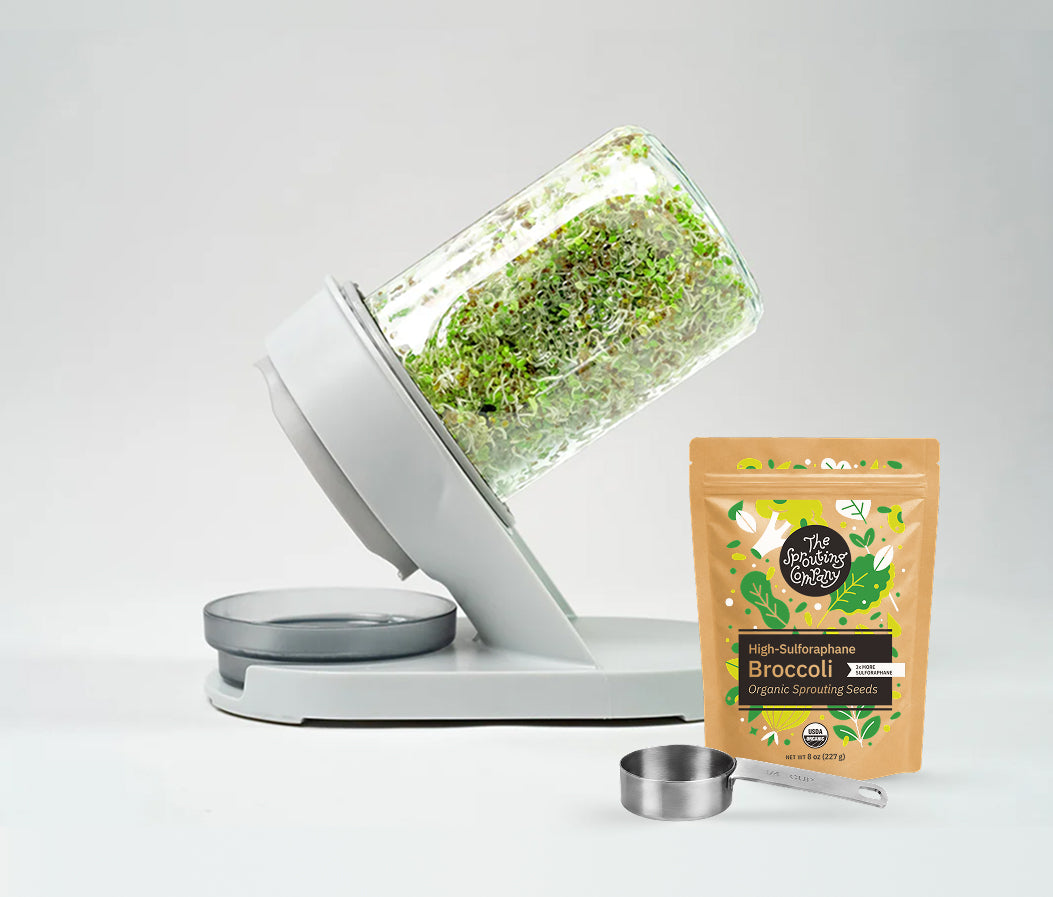
Using the scooper, add seeds to the Sprouter, cover with water and soak for 8 to 10 hours.

2
Rinse and drain twice a day.
Watch sprouts emerge in 2 to 5 days.

3
Harvest fresh food.
Once sprouts reach 1 to 3 inches, rinse, dry and enjoy fresh in meals.
Get the Starter Kit
From people who started with a jar

“I've been germinating seeds for 40 years for myself and the parrots I used to have. This system is brilliant. Very similar to the method I was using with Mason jars but much better! Much larger capacity, too! VERY happy with this sprouting kit!”
Beverlee B. | Verified review

“I use sprouting trays and mesh lids for mason jars from other companies but was very disappointed in the results of both. In fact, I gave up on sprouting... I gave it another shot. I am so glad I did.”

“Love that I did not get mold like I had with the mason jars.”


What it is made of
The vessel is soda-lime glass, the same glass used in Pyrex. The filter is 304 stainless steel. Those are the only two surfaces your sprouts ever touch. The base and stand contain no PFAS and never contact your food.
50 oz capacity
One-year warranty

Warranty One year. If your sprouter stops working the way it should, we will repair or replace it.
Seeds Certified organic and non-GMO. Protected by SproutArmor™ proprietary seed treatment. SproutArmor™ means every batch of seeds is pathogen tested before it ships, adding an extra layer of care before seeds ever reach your counter. It's one part of a broader food safety program built around growing with confidence at home.


FAQs
Why not just use a mason jar?
A sprout is a seed that has woken up. Give a dry seed water and a few days, and it starts building a plant: growing a root, unfurling a stem, and synthesizing nutrients it never had while it was dormant.
You eat the whole thing, seed and stem and all, usually three to five days in. No soil, no sunlight, no garden. Just seeds, water, and about a minute of your attention twice a day. Welcome to one of the most nutrient-dense foods on Earth!
Do I need a green thumb, a garden, or a sunny window?
None of the three. Sprouting happens indoors, in water, on a countertop, and sunlight is not part of it.
If you can rinse a colander, you can do this. That is the whole skill.
How much time does this take every day?
About a minute, twice a day. You rinse, you drain, you walk away.
Most people fold it into things they already do. Rinse when the coffee is brewing, rinse again after dinner.
How fast until I am actually eating something?
Legumes like lentils and green peas are ready in about three days. Leafy sprouts like broccoli, salad mix, alfalfa and clover take five to six.
Either way you are eating food you grew inside of a week, which is the part most people do not believe until they do it.
Which seed should I start with?
If you are here for the nutrition, start with High-Sulforaphane Broccoli. It is our most researched seed and the reason most people find us.
If you want something that goes on everything and pleases everyone at the table, start with High-Sulforaphane Salad Mix. Broccoli, radish, mung beans and green lentils in one harvest, so you get variety in texture and flavor without running two batches.
If you want protein, start with Lentils or Green Peas. They are also the fastest, which makes them a satisfying first win.
What is the difference between sprouts and microgreens?
Sprouts grow in water, take three to five days, and you eat the entire plant including the root and seed. Microgreens grow in soil or a growing medium, need light, take seven to fourteen days, and you cut off the top and leave the roots behind.
Sprouts are faster, need less equipment, and give you more food per square inch of counter. That is why we build around them.
Will I actually stick with it?
More people do than you would expect, and the reason is that the feedback loop is fast. You see visible change every single day, and you are eating the result inside a week. Most healthy habits ask you to wait months for a payoff you cannot see.
The system is built for the sticking part too. The sprouter sits on your counter where you cannot forget it, and the daily job is small enough that skipping it never feels worth it.
Get the Starter Kit

